
In this episode, the Pharisees, together with the Herodians, lay a trap for Jesus by trying to draw him into the political controversies of the day. The Herodians, for their part, were not natural allies of the Pharisees. They were, as their name suggests, supporters of Herod, the Roman puppet king, and thus collaborators with a foreign, occupying power. The Pharisees, by contrast, were no enthusiasts of Roman rule, but they at least did not espouse violence. The same could not be said, however, for a third group, the Zealots, who would, over the course of the next hundred years, lead two disastrous rebellions that would end in the destruction of Jerusalem and the definitive exile of the Jewish people.
(more…)-
-
Once again we find ourselves with another parable about a vineyard, but whereas the last few Sundays the focus of these parables has been on God’s mercy, has been on the fact that God allows ample time and ample help in order that sinners might turn from their wickedness and be saved, here the emphasis shifts to focus more directly on God’s judgement. Of course, these two things, mercy and judgement, really do go together – judgement and mercy form a sort of binary, just as a coin has two sides or as a magnet has two poles – for either we accept God’s offer of mercy, or else we will experience his judgement.
(more…) -
No matter what circumstances we find ourselves in, we always have it within our power, aided by grace, to choose Christ, to conform our wills to that of the Father. That grace helps us in this we find explicitly confirmed in scripture, as St. Paul reassures the Corinthians by saying: God is faithful and will not let you be tried beyond your strength; but in the trial he will also provide a way out, so that you may be able to bear it. And so temptation can never overpower us unless we consent to it, meaning that we always have it within our power, helped as we are by God, to preserve rectitude in our wills, to remain united with Father, who has united us to himself through Christ.
(more…) -
Everyone knows that as Christians, we are called to forgive. Indeed, forgiveness might be the paradigmatic Christian action, since Jesus came to forgive sins, and even as he was dying on the Cross he was forgiving his executioners.
(more…) -
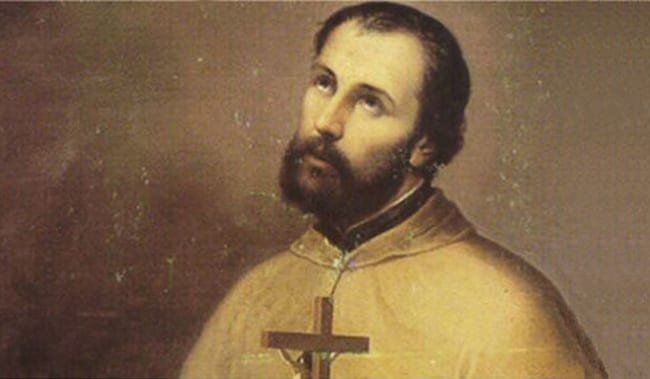
St. Peter Claver, whose feast we celebrate today, like many young Spaniards in his day, was drawn to the noble task of serving in the New World missions. Leaving Spain forever, the young Jesuit left for the Mission of Columbia, where he was ordained in Cartagena in 1616. He would go on to spend the rest of his life there, utterly spending himself until he died in that city in 1654.
(more…) -
St. Athanasius has a famous line in his On the Incarnation, which is quoted in the Catechism, in which he says, “The Son of God became man so that we might become God.” This does not, of course, mean that Christ came in order that we might be become God in the sense of sharing his incommunicable attributes, such as his omnipotence, omniscience, his simplicity and everything that flows from that. But in so far as a creature can participate in those attributes of God which are communicable, in other words, insofar as a creature can become like God while remaining a creature – it is for that that Christ came.
(more…) -

As you probably know, I love to whitewater kayak, and especially during the summer you can find me basically everyday that I have off and every Sunday afternoon on the Ocoee River near my hometown of Cleveland, TN. Now on the Ocoee, literally on just a handful of rocks, there grows a species of flower that is found nowhere else on earth, called Ruth’s golden aster. It’s this small, yellow-flowering plant that clings to the crevices in these big boulders in the middle of the river.
(more…) -
We read in Isaiah that as the heavens are higher than the earth, so are my ways higher than your ways and so my thoughts than your thoughts. We saw a demonstration of this in last Sunday’s gospel, when Peter confessed Jesus to be the Christ, the Son of the Living God, a confession that came not from flesh and blood, not from human reasoning, but rather from a divine illumination by which God had revealed this marvelous thing to Peter. So high are the ways of God above the things of men, that is to say, that only by such divine help could so wonderful a thing be spoken.
(more…) -
But who do you say that the Son of Man is? This question that our Lord directed to his disciples in Caesarea Philippi is a question that every Christian, and indeed, given the global reach of Christianity, every person, Christian or not, must answer. The question of who Jesus is is a question that, once asked, demands a response, a response that at least has the potential to alter the course of one’s life.
(more…) -
This deliverance of the Canaanite woman’s daughter is one of those episodes in the gospels that, at first blush, might cause us confusion, as Jesus seems to behave strangely. Yet whenever Jesus challenges us in the gospels, whether it be by his words or by his actions, there is, within that challenge, always an invitation to go deeper. Scripture does not always surrender its treaures on a cursory reading, and so if we want to truly understand what is happening in these challenging or obscure passages, then we have to resist any temptation towards knee-jerk reactions, and instead exercise one of those very virtues which the Canaanite woman exhibited in her continual crying out for help, namely perseverance, as we wrestle with the scriptures.
(more…)

