
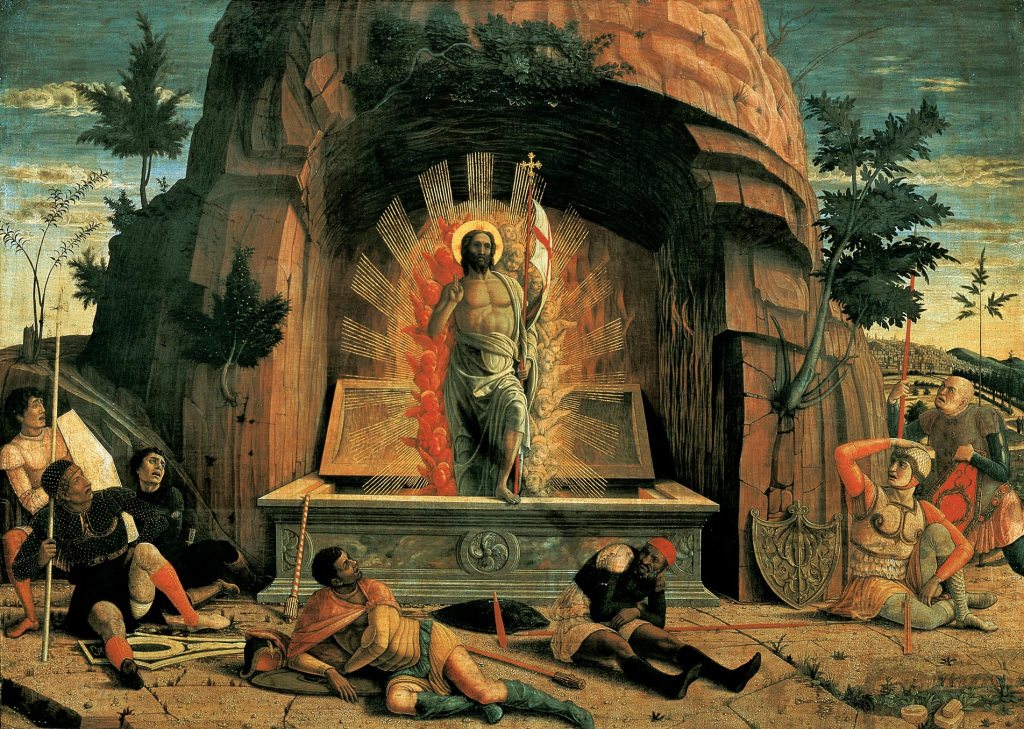
No one comes to the Father except through me. If you know me, then you will also know my Father.
These words, and indeed this entire passage, are very Trinitarian in character. As Christians we of course believe in the Trinity, and indeed the truth of the Triune nature of God is so indispensable that one cannot be a Christian without it; it is one of the requirements for the validity of baptism that it be done according to the Trinitarian formula and with a Trinitarian understanding, such that groups who baptize without this belief, such as the Unitarians, Jehovah’s Witnesses, and Mormons, do not actually baptize at all and so are not really Christians.
And in saying that, it can perhaps sound a bit harsh, as if we are to trying to circumscribe the Kingdom of God according to obscure theological points. Why is not enough to simply believe in God, one might ask. But if we are tempted to think in such a way, then it is clearly because we have not ourselves grasped the profundity of what has been revealed and offered to us in Jesus Christ, which, as we see here in this gospel, is of its very nature Trinitarian.
Because if we go back in time to the first century and to the centuries that immediately followed, we will find there a robust culture that was by every measure quite religious. Atheism had long before been suggested by certain Greek thinkers, and had, especially by Greek thinkers and by the intellectual elites of the Roman world, been rejected as an inadequate explanation for reality. In its place, what prevailed was not so much a naïve and silly polytheism, where people believed in these anthropomorphic beings who literally lived on Mount Olympus (though some likely did), but rather a polytheism that expressed or emanated from a transcendent One, the gods of Homer and Hesiod being conceived as intermediary beings between the One and the world. What you could perhaps call the True God, the One, was believed to be so utterly transcendent that next to nothing, or perhaps even nothing at all, could be said about it, and it was certainly only the lower emanations of this transcendent One that could enter into relationships, and that could care about earthly creatures.
And so consider how revolutionary the doctrine of the Trinity must have been in such a context. Here is a God is truly One, who is truly transcendent and perfect just as the philosophers had believed. And yet, without losing any of that transcendence, He is, in His very nature, defined by relationship. He is not, after all, static and alone, but is dynamic, interpersonal activity – the Father giving everything that he is to the Son, the Son returning everything that he is back to the Father, in an interplay of infinite love so profound that it becomes, timelessly, a third hypostasis, the Holy Spirit.
It is precisely this dynamic of divine love that breaks into history with the Incarnation. This is what it means for the eternal, transcendent, perfect, ineffable One to become immanent in time: that this Triune life, this Triune love, has become immanent in time, and everything that Jesus does is revelatory of that love and invites us to enter into that love and into that life. This is why Jesus speaks as he does in this gospel: How can you say, ‘Show us the Father’? Do you not believe that I am in the Father and the Father is in me? The words that I speak to you I do not speak on my own. The Father who dwells in me is doing his works.
To deny the Trinity, then, is not to deny some obscure theological dogma, but is rather to deny the very work, the very mission, the very identity of Christ. It is to say, blasphemously, that God is too transcendent for us to stand in relation to him, to say that Christ is not actually possessed of divine life, and that the life of God has not really been made available to us.
Because that is truly what is happening in the Christian life. In the Christian life, we are being invited to enter into the very life of God, to share, in a participatory way, in the very being of the ineffable One whom the pagan sages thought was impossibly beyond our grasp. And so in baptism, what we have is not some mere outward ritual, not some mere sign, but rather an efficacious sign by which we die to our old life and are reborn as members of the mystical body of Christ, a body which is animated in all its members by the life of the Most Holy Trinity. The gift of that life, which is the life of the Holy Spirit, is deepened and brought to greater perfection through Confirmation, which we celebrated for our young people last weekend, and its fullness and its sustenance through the sacrament of this altar, the most holy Eucharist.
Because even though we truly come to share in the divine life by our baptism and are confirmed in that life by the Holy Spirit, we yet remain creatures that exist in time. And even as our natural life is sustained by the ongoing nourishment of natural food and natural drink, even so is our supernatural life sustained by supernatural food and supernatural drink. Our salvation consists in our remaining in that life, and we remain in that life by remaining in Christ, and we remain in Christ by becoming what we consume: his very Body and Blood.
As our Lord said: I am the way and the truth and the life. No one comes to the Father except through me. If you know me, then you will also know my Father. From now on you do know him and have seen him. And where do we know him? Where do we see him? In the breaking of the bread, in the blessing of the cup, in the body and blood of Christ once offered for you on Calvary, and made available to you now through the Sacrament of the Altar.


Leave a comment