
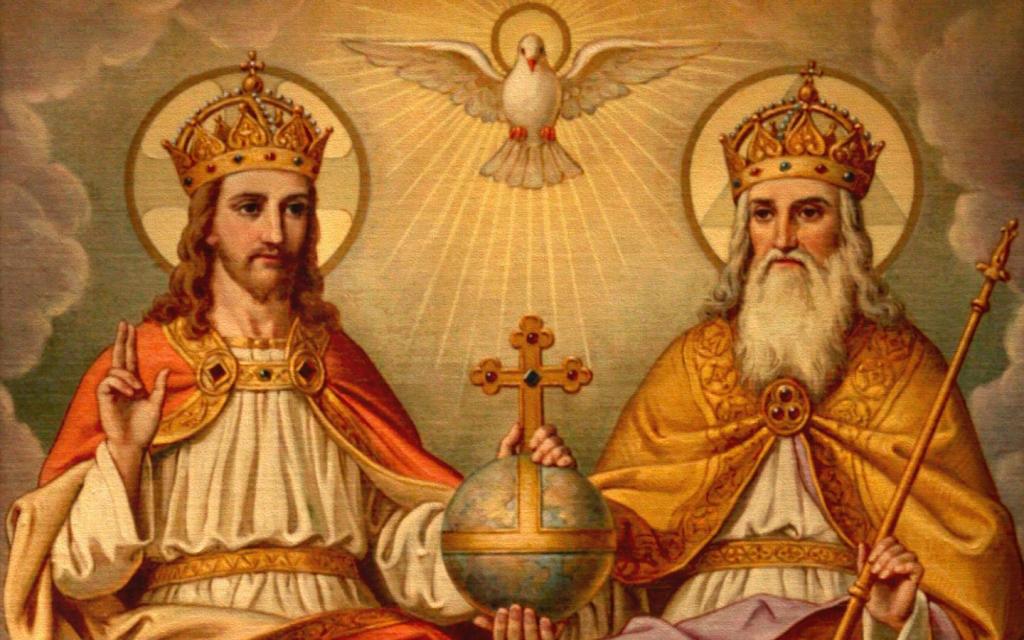
In our first reading, Moses goes up a mountain to meet God. And when he gets there, God reveals himself, showing to Moses his ineffable glory, revealing his name and declaring himself to be merciful and gracious, rich in kindness and fidelity. This encounter of Moses, the man, the creature, with God, the infinite, the absolute, the inexpressible, is glorious, wild, and awesome. Moses has gone up the mountain, and, in an event almost too wonderful to be believed, has seen the glory of God.
Yet even in this encounter, there is still a distance. For Moses prays, If I find favor with you, O Lord, do come along in our company, and receive us as your own. Even with the great richness of this revelation, Moses longs for more. How remarkable! He sees God, he speaks with him, he hears him declare his secret name, and yet still he cries out for God to come near! He stands in God’s presence, yet his heart still longs for an as yet unfulfilled union with the divine! How restless he is! Because for all the glory of his self-revelation on the mountain, God is still other than Moses, he still stands apart, over there, and Moses wants more.
And he ought to want more. We ought to want to more. For the good news of Christianity is not simply that we are able to see God or that we are able to know true things about him. In Christ, we have not been given a general report about God, or some theological treatise explaining who God is. If that were all that our faith offered, then how fulfilling would that be? It would be like reading a biography of someone you never get to meet, or watching a video of a person you never get to encounter. It would be pointless, ultimately, it wouldn’t reach us. We would still be in the position of Moses: God would have shown himself, yet he would still remain apart. And like Moses, we would be left longing for more.
But, in fact, the good news of Christianity is this: God has heard the prayer of Moses, and he has come near to us. He has not remained apart. For God so loved the world that he gave his only Son, so that everyone who believes in him might not perish, but might have eternal life. In taking a human nature to himself and walking and dwelling among us, God himself has come into our company, just as Moses prayed he would, but more than this, he has in his coming revealed himself anew, in a way far more profound than in that ancient revelation to Moses on Sinai.
For in his coming near to us in the God-Man Jesus Christ, fully human and fully divine, God has not merely told us who he is, but has rather shown us, from the inside, who he is. In Jesus, we have access to God’s inner life, and we see that it is more marvelous than we could ever have imagined, indeed it is the greatest and most ineffable of all mysteries, a thing not to be explained so much as to be experienced. For we see, in the life of Jesus, that God is marked in his inmost self by relationality, that in the midst of the perfect unity that is the one God there is, counter to all our expectations, a plurality: the Father eternally generating the Son, who lovingly returns all he has been given to the Father, and the Spirit proceeding from them both. And so we see that the inner life of God is communal, and that true unity is the unity of love, that in the deepest recesses of himself God is always giving himself, that he is always loving, and that through the coming of Jesus Christ we are invited to enter into that love, to enter in to the divine life, to participate in this Trinitarian dance of giving and receiving that stands revealed as the ultimate foundation of all reality. This is what it what it means for us to be saved through Jesus Christ, as through the Son we are caught up into the beautiful reality of God’s eternal life.
This is the mystery we were baptized into, the mystery we were strengthened in by the Holy Spirit in confirmation, the mystery that comes to us when we partake of the Body and Blood of Christ in this Eucharist. And so the revelation of God as Trinity has changed us, most profoundly in the sense that our salvation is only in and through the Triune God, but also because it teaches us that if we desire eternal life, then we need to love how God loves, that we need to give ourselves away in love as God does, just as Christ did on the cross.
And if there is a concrete, actionable realization that we can take away from reflecting on the Trinity, it’s that. The life of the Christian, grounded as it must be in the inner life of God, reaches its fulness only when it is given away. In other words, the more we cling to our time, to our wealth, to our ambitions, that is to our own self-centered smallness, the more this life becomes a sort of creeping death, until, ultimately, in our miserable selfishness, death finds us and becomes absolute. But instead, if we give ourselves away, if we renounce our plans and ambitions and offer everything to the will of the Father, that is if we empty ourselves like Christ did, then we will have life abundantly, and death will never find us, because we will be grounded in the inner life of the Triune God that is life and goodness itself. If we want life and happiness, we need to be open to what God is inviting us to and be willing to say yes, even if he’s inviting us to something that can feel daunting. But, in any case, as we continue with our liturgy, and as we prepare to approach this altar where God condescends to meet us in the breaking of the bread, let us be grateful to the Lord for hearing the prayer of Moses. For God has indeed come near, and in his only Son Jesus Christ there is no longer any distance between us, for he has received us as his own, into his very life, made known to us in the triple appellation of Father, Son, and Holy Spirit.


Leave a comment