
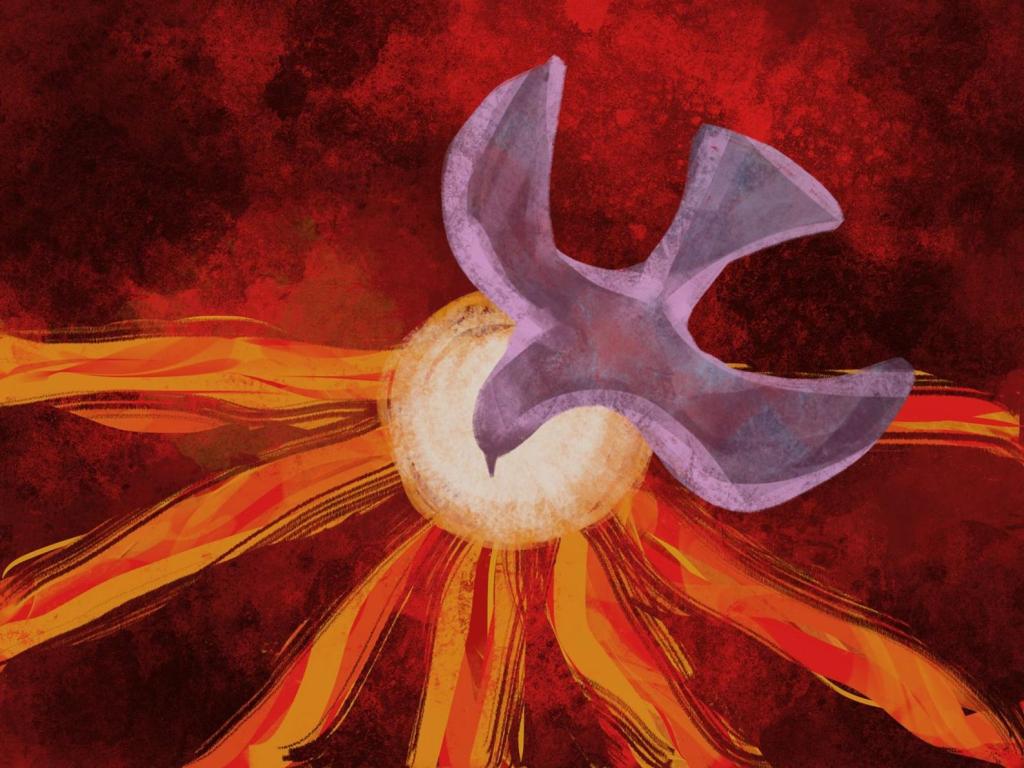
On this great feast of Pentecost, which we anticipate joyfully every year as the crown and completion of the Easter season, we remember and celebrate what is, without any doubt, among the greatest of gifts ever given to the Church, namely the gift of the Holy Spirit, who was, after Christ’s ascension, as Christ himself had promised, poured out upon the disciples while they were at prayer, and who has, ever since that moment, remained always with the Church.
And so what was, what is, this gift? Above, the Holy Spirit is God himself, the third person of the Most Holy Trinity, who has come to dwell in us, in those of us washed clean by the waters of baptism, anointed with the oil of confirmation, and made worthy to be partakers of the divine life by the worthy reception of Christ’s body and blood in the Eucharist. The descent of the Holy Spirit upon the Church, upon us, is then, even in this life, an anticipation of the life of Heaven, for even now, by the Spirit’s presence within us, our life is being taken up into the inner triune life of God.
So that’s the short answer to the question of what the gift of the Holy Spirit is. Chiefly, it is the Spirit himself. But, beyond this, or perhaps rather because of this, what does the gift accomplish? How is it that we, and the Church generally, experience this indwelling of the Spirit of God within us?
Scripture gives us many avenues for approaching this question. First, when we consider the initial Pentecost event, when the Spirit descended like tongues of fire upon the disciples in the upper room, enabling them to speak in many tongues to the many pilgrims from many nations who had traveled to Jerusalem for the Jewish feast of Pentecost, we see a reversal of that scattering of the human race that had taken place after God confused their languages at Babel. And this teaches us that, ultimately, the division of the human race into different tribes and tongues is to be no obstacle to the proclamation of the gospel, that indeed the gospel is to be preached in every language to every people, that the Church is to be Catholic, that is universal, and is to accomplish within itself, that is within Christ, a renewal of that original unity of all the human race in the friendship of God that had existed before the fall. And it is the Spirit that enables the disciples to accomplish this, that enables them to make themselves understood, that gives them the courage and the conviction to announce the good news of Jesus Christ, that gives them the zeal to be evangelists of the gospel to the ends of the earth, even in the face of suffering, hardship, and even persecution and death.
It is also the Spirit, as St. Paul and others remind us not infrequently, that moves us to faith. No one can say “Jesus is Lord” except by the Holy Spirit, as we read in First Corinthians, and it is the Spirit who helps us to pray, who comes to the aide of our weakness, interceding with inexpressible groanings, as we read in Romans. And then, too, it is the by the Spirit that the sacraments of the Church are celebrated. It is the Spirit that we invoke upon the baptismal waters, it was by breathing the Spirit upon the apostles that Christ conferred upon them the power to forgive sins, and it is the Spirit who comes upon the gifts presented on this altar, that they might become for us the body and blood of Christ.
And so, we can say that the gift of the Spirit is the gift of God himself come to dwell among us, a Spirit who is a Spirit of unity, of evangelistic zeal, a Spirt of faith in Jesus Christ, a Spirit of prayerfulness, penance, and forgiveness, and above all a Spirit of holiness that leads us to holiness, that makes us like Christ.
And so it should be evident, then, that the Spirit is not a gift that is given only to a few, but is rather a gift that is given to all, and that indeed has been given to each and every one of us here present. The Spirit was poured upon us, just as truly as it was poured upon the disciples in the upper room, in our baptism and confirmation. The Holy Spirit is with us every time that we partake worthily of the Eucharist. The Holy Spirit is present at every marriage and every ordination, at every anointing and in every confessional.
Thus, when we think about the gift of the Holy Spirit, when we think about the ways in which we have received the gift of the Spirit, we should think above all in these sacramental realities in which we are all partakers, because these are the highest mysteries of our faith and the greatest gifts that God has given to us. This is not to deny that that there are other gifts, that the Holy Spirit can give particular blessings and charisms to individuals, but these should always lead us back to those things that are at the heart of the Holy Spirit’s action in the Church: the sacraments, unity, and love. The Holy Spirit, in other words, will never lead us away from Holy Mother Church. He will never lead us to some other authority other than the bishops in communion with the successor of St. Peter; for he is not a Spirit of sectarianism or private interpretation or individualism.
And so, on this feast of Pentecost we pray for a new outpouring of the Holy Spirit upon all of us, and upon the entire Church, an outpouring that, in every expression that it may take, is marked by an increase in those things with which the Holy Spirit is most intimately connected: an increase in unity, in faith, in forgiveness, in love, and in holiness. In other words, in praying that the Spirit be poured out upon us in a new Pentecost, we pray for nothing other than that we might become more closely and more thoroughly configured to Jesus Christ our Savior.


Leave a comment