
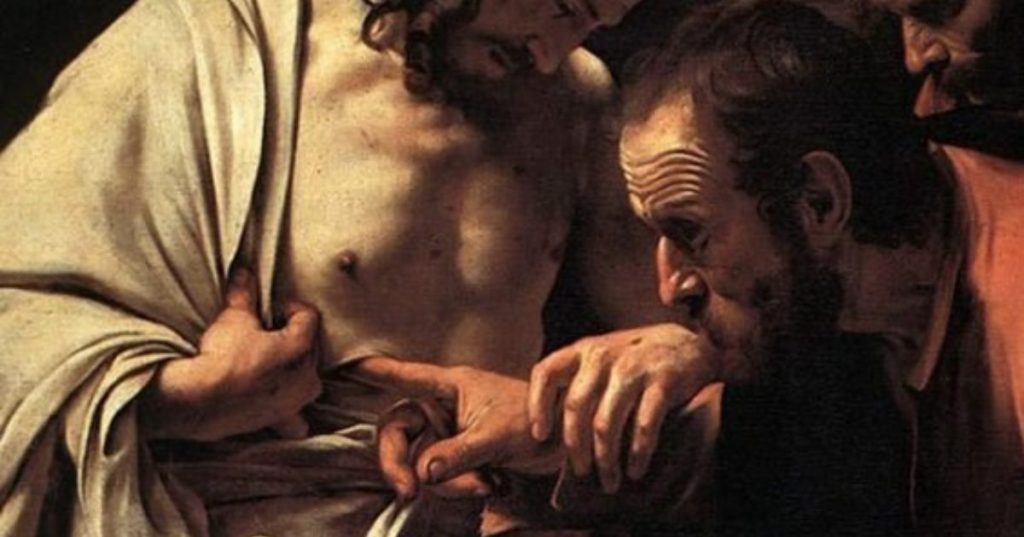
The name of St. Thomas, on account of this famous episode, is always for us connected with doubt. It is as though we have been so conditioned to make the mental jump from the name of Thomas to Doubting Thomas almost without thinking, and surely there is something unfair about that. Yet at the same time, there is certainly an element of hard-heartedness in Thomas’ initial unbelief, when the other disciples, whom Thomas knows and trusts, have seen the risen Lord and have testified to Thomas regarding the truth of the Resurrection. And so when we hear Jesus’ words to Thomas, Be not unbelieving, but believe, we may rightly hear in them a gentle sort of rebuke, as Thomas’ doubt, however psychologically understandable it might have been, was in the end unreasonable.
And it is psychologically understandable that St. Thomas should doubt, given the enormity of what is being claimed, and how personally it must have touched him – this possibility that his master, his teacher, his friend, who had suffered so horribly, was alive again – perhaps it was out of a desire to protect himself that Thomas is slow to accept this.
But far more important than the question of whether or not Thomas should or shouldn’t have doubted, is the manner in which God uses this doubt to his glory. For think of it: is it not one of the greatest moments in the scriptures when Jesus does appear and allows Thomas to see the wounds in his hands and in his side? And does it not lead to one of the greatest professions of faith, as Thomas proclaims My Lord and my God? For these moments, I would argue, the momentary doubt of Thomas is a small price to pay.
And so, what lessons can we draw from this? The first, I think, stems from the fact that Jesus’ appearance to Thomas certainly shows that Thomas’ doubt was not well placed. Thomas should have believed. For, as we just said, Thomas was told that Jesus had risen from the dead by people who had seen him, by people whom he knew, and who were trustworthy. The vindication of their testimony only underlines the fact that they should have been believed from the first instant. And so if there is a moral failing in Thomas’ doubting, it is perhaps the mistake of thinking that the only evidence that mattered was the evidence to which he himself had access. There is an unhealthy individualism in this, as it amounts to the idea that we have to rely entirely on ourselves in matters of faith, as if our own personal experiences of God were all the experiences that there are. Of course, we don’t think this in any other area of our lives, and we shouldn’t think this way here either. I have never been to Australia, for example, but I have no doubt that it is there, and, similarly, as Christ reveals to Thomas, Thomas really should have believed at the word of his friends who had seen him.
Thus Christ says, blessed are those who believe who have not seen, for it is such persons as these who doing as they ought to do. And so even though you and I are not personal witnesses to the resurrection, we nevertheless know, as a matter of historical certainty, that the tomb was empty, that those who knew Jesus claimed to have seen him alive after his death, and that this ironclad conviction became the bedrock of a faith that they went to death professing, and none of this is to even make a theological or a religious claim! It is these historical facts, as historical, that invite us to faith, since they justify us in believing, as a matter of history, that the resurrection really happened and that, consequently (and this is the religious claim) Jesus is who he claimed to be. [And if you’ll permit me an aside, this is one of the most frustrating things about a particular type of historian, and one of the chief causes of the secular spirit of our age, and that is when historians or even people who are simply reading history dismiss the miraculous as a matter of course, either because they’re overly impressed by certain subtly circular arguments of David Hume or else because they think, for some reason or another that the miraculous is simply outside the bounds of history. But of course, to actually approach history on its own terms shows how ridiculous this is, for if there is anything that the historical record shows, it is a practically unanimous attestation to the reality of the miraculous. And so if we cannot find the miraculous in history, then it is because of philosophical presuppositions that we have brought with us in our study, and it has nothing to do with history itself. There is hardly a historical case to be made, for instance, against the reality of St. Joseph of Cupertino’s levitations, or against the Marian apparitions at Fatima, or against the resurrection, given what we know from the historical record.] And so, getting back to the point, we can trust the scriptures, we can trust that God works in powerful ways, that he is close to people (at times in ways that are truly remarkable), and even if we personally haven’t had any remarkable experiences, that there are many people who have, many whose word is trustworthy – there are many saints and mystics, St. Faustina among them, who have seen farther than you and I – and some such witness to the remarkable are, I imagine, even present in this parish.
But then, even for those who are bereft of such experiences, for those who, like Thomas, are left to rely on the testimony of others, and are allowed even to fall into doubt, such doubt may yet be redeemed. It was because he doubted, after all, that St. Thomas came to put his fingers in the wounds of Christ and so come to faith, and so too for many, many believers – their faith would not have been were it not for their doubts. For doubt has this power, if one responds to it rightly: to move one to seek deeper wisdom. It has this ability, not only in the realm of faith but in other areas as well, to occasion the asking of questions and the seeking of answers and, ultimately, to a growth in knowledge and understanding. Doubt, in this way, plays a similar role in the intellect as hunger and thirst play in the body, moving us to seek that which will satisfy our nature as rational beings.
And so it happens often enough, frequently amongst the young but certainly not amongst the young only, that a person, having been raised with a simple understanding of the faith, comes to have questions, comes to have doubts. And that in itself is no unhealthy thing, for as we mature our faith also needs to mature, and especially in our post-Christian culture, a child’s understanding of the faith is not sufficient for perseverance, and the need for a more mature faith can be experienced as doubts in a childish one. And, as you will learn very quickly from talking to many converts and reverts, their journeys were oftentimes marked by precisely this movement from a childish doubt to mature faith. And that may require some work – it may mean reading some books or listening to podcasts or talking with people who know more than you. But such work will come easily enough to one who is a true lover of wisdom, who is ruled by a sincere desire for the truth, and who does not take their doubt as an excuse, either consciously or unconsciously, for moral licentiousness, but takes it instead as an invitation to cast out into deeper waters.
And where does all this lead? Whether it be trust in what has been handed down to us and in what others have told us of their experiences or whether it be our own understanding, prompted and deepened by struggle with doubt, it leads to the same end, to that same profession of faith that, more than any doubt, is the lasting legacy of St. Thomas: to look upon the Risen Christ, and to say, rejoicing: My Lord and my God.


Leave a comment