
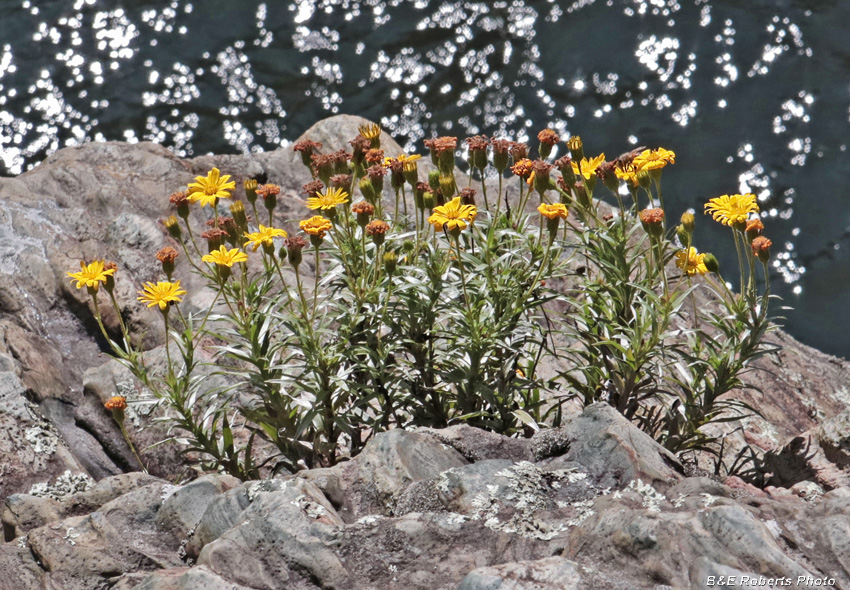
As you probably know, I love to whitewater kayak, and especially during the summer you can find me basically everyday that I have off and every Sunday afternoon on the Ocoee River near my hometown of Cleveland, TN. Now on the Ocoee, literally on just a handful of rocks, there grows a species of flower that is found nowhere else on earth, called Ruth’s golden aster. It’s this small, yellow-flowering plant that clings to the crevices in these big boulders in the middle of the river.
Now, naturally the federal government has taken steps to protect these flowers. There are these big metal plaques drilled into the rock warning rafters and kayakers that they’re forbidden from climbing or taking a break on those boulders. And I think everyone, more or less, Christian or non-Christian, can understand why that’s appropriate. Here is something unique, something unrepeatable and rare, and were this plan to be trampled under foot into extinction that would be a real and permanent loss.
But I think that as Christians, we ought to be able to see more clearly why that is so, why the uniqueness of that plant matters. Because, frankly, if all we have to go on is our bare intuition that “this is a nice flower and it should be protected” then we’re not very well equipped to respond to those who would merely shrug their shoulders, nor are we well equipped to resist the opposite extreme of treating the natural world as if it were an end in itself and succumbing to what is practically a kind of nature worship, which you see too often with a certain set of environmentalists.
Instead, the Christian way of appreciating the natural world lies precisely in our ability to recognize the natural world as creation. What we see before us in the natural world is not the result of blind chance or sheer luck, but is instead something that has come forth by the will of God in order to manifest and communicate his divine goodness, every little thing reflecting, in its own very limited way and very specific aspect, some small part of the divine character. It’s because of this that the mind can move from created things and by way of created things to what is uncreated, as we perceive the handiwork of God and even the shadows of God’s own perfection in created things, even on the level of a small flower growing on a boulder in a corner of some Tennessee river.
And I think, just from what’s been said, that there’s enough there to motivate a care for creation, but in the Incarnation this gets heightened to a far greater degree. Because in God taking on human flesh, entering into creation in order join himself to and thereby save the human race, the purpose of creation, the purpose of the natural world is crystalized. The world exists, that is, precisely in order to mediate this union between God and man, and this purpose is most fully realized here in the liturgy.
The mass, you see, is not something that merely involves us, but also the whole of creation. We see this in the physical elements that we bring to the altar: bread and wine, as well as in other sacramental matter, such as the oil for anointing and the water of baptism, to say nothing of sacramentals such as holy water, blessed salt, and even the bones of the saints. We see this incorporation of the natural world into our worship in the way in which we traditionally orient ourselves during our prayer, facing together towards the east, towards the rising sun, a natural symbol of the resurrection, of the new day that has dawned in Christ, and of the certainty of Christ’s coming again. (Which is why, even if we do not do so typically, it is most appropriate that in this mass, as we attempt to recover a more cosmic sense of worship, that we adopt this ad orientem posture).
Because the essential thing, I think, if we want to safeguard the care of creation, making it clear why care of the natural world ought to matter to Christians as well as avoiding any quasi-pagan or superstitious excesses, is to rediscover the fundamental orientation of the created world towards worship. The natural world after all, has come from God and groans with us in eager expectation for that promised liberation from decay towards which this liturgy points and which even now has begun in us who belong to Christ.


Leave a Reply