
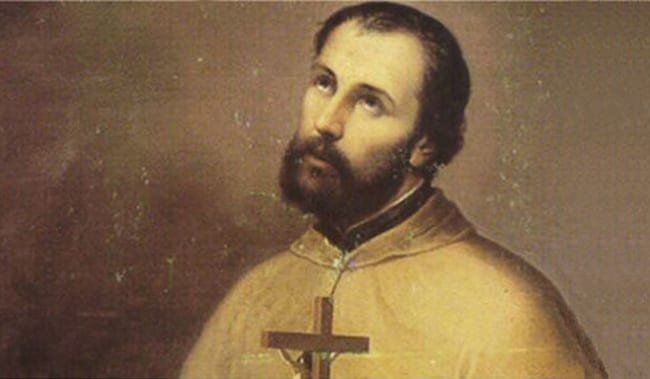
St. Peter Claver, whose feast we celebrate today, like many young Spaniards in his day, was drawn to the noble task of serving in the New World missions. Leaving Spain forever, the young Jesuit left for the Mission of Columbia, where he was ordained in Cartagena in 1616. He would go on to spend the rest of his life there, utterly spending himself until he died in that city in 1654.
When we think of the New World missions, we think primarily of the missionary work that was done amongst the natives, but St. Peter dedicated himself to the slave ships. Cartagena was in those days a terrible slave port, and St. Peter and his companions would meet every slave ship they could as it arrived in port, and with blankets, citrus fruit, aromatics, and other such goods, they would tend to the slaves, especially the sick and the dying. Now, it is important that we not forget how terrible these conditions were. A slave ship was the very image of hell. The men whom St. Peter served were shackled and starved, naked and shivering, lying in puddles of excrement or on mounds of broken tile and bricks; in time St. Peter even lost his sense of smell and taste after years of breathing such noxious fumes.
And what would St. Peter do in these horrible places? He would first of all distribute food and blankets if he had them. He would bathe the wounds of the sick and injured with wine, and would show these poor men human kindness, so as to hearten and encourage them. And for what he did next, allow me to quote from one of his letters, dated May 31, 1627:
“After this we began an elementary instruction about baptism, that is, the wonderful effect of the sacrament on body and soul. When by their answers to our questions they showed that they had sufficiently understood this, we went on to a more extensive instruction, namely, about the One God, who rewards and punishes each one according to his merit, and the rest. We asked them to make an act of contrition and to manifest their detestation of their sins. Finally ,when they appeared sufficiently prepared, we declared to them the mysteries of the Trinity, the Incarnation and the Passion. Showing them Christ fastened to the cross, as he is depicted on the baptismal font on which streams of blood flow down from his wounds, we led them in reciting an act of contrition in their language.“
Faith formation was not a trivial thing for St. Peter. Food, water, medicine, kindness, and catechesis – these were all equally urgent, and indeed, catechesis was in a sense the most important of them, since it was this that prepared the way for eternal life, and which alone had any kind of power to bestow some redemptive meaning on such terrible suffering. In fact, faith formation was so important to St. Peter Claver that it can’t but occasion in us an examination of conscience – here we see a man who became a slave to slaves, who rushed in to the most terrible places on earth, sacrificing his health, for the sake of sharing the gospel with the most downtrodden people on earth. And here we are, in such relative ease and comfort such that we can scarcely imagine the hell of a Spanish slave ship – we face none of the obstacles that St. Peter did – but do we still have his urgency to draw close to Christ, and to share the gospel with others?
For you parents I think this is an especially important question. I do not doubt that you would lay down your lives for your children in order to keep them fed and healthy and clean. But would you do the same to ensure their knowledge of Christ? For if we are neglectful in that, if we are neglectful in Sunday mass or regular confession or daily prayer, then we are neglectful of that which is most important.
And what all of this points to, I think, is that great privilege that we have to be here today. As students to learn about Christ, and as teachers and parents to share our love of Christ with others. That is something that we should never take for granted, and something that we should give thanks for as we gather around this altar: that we have this privilege to gather around Christ, our Eucharistic Lord, as we strive to grow in our knowledge, our love, and our discipleship of him.


Leave a comment