
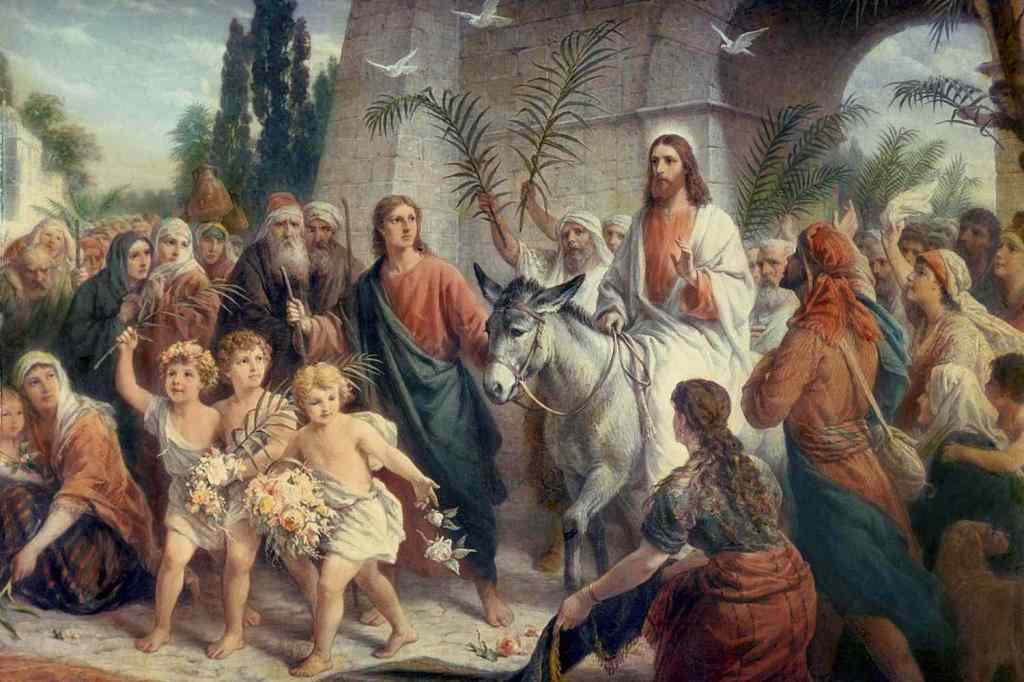
We have just heard St. Matthew’s account of our Lord’s passion, from his entry into Jerusalem to his death and burial. It is an account that, however familiar it might be to us, yet moves us again and again to compassion for this innocent man, cruelly tortured and put to death by the very ones he came to save.
On a merely human level, this is an incredibly tragic scene. But there is more here than tragedy, and to see it requires more than ordinary vision; we need also to see by the twin lights of understanding and of faith.
For while on the physical level we see a good man abandoned by his friends and condemned to a cruel and undeserved death, we must not forget our second reading, which is perhaps my favorite passage in all the New Testament, and which gives us the key to understand what we have just heard: For though he was in the form of God, Jesus did not deem equality with God something to be grasped at. Rather he emptied himself and took the form of a slave, being born in the likeness of men. He was known to be of human estate, and it was thus that he humbled himself, obediently accepting even death, death on a cross!
It’s a natural question to ask why our salvation was achieved by such painful means, to ask why there had to be so much suffering. And the short answer is that there didn’t have to be. God is absolutely free, and he could have chosen any means he pleased to save us. But God chose to suffer the humiliation of the cross, and if we approach this mystery in the spirit of fides quaerens intellectum, we discover that it was fitting and more than fitting that God should chose to suffer as he did in the human nature that he had assumed to his Divine person.
For consider the condition of the human race as it was, separated from God by sin, by our own willful disobedience in prefering lowly creatures over our creator – a choice made first by Adam and then ratified by each and every one of us. Having thus separated ourselves, how can we bridge this gap between a sinful humanity and the all-holy God? How can we, finite as we are, reach out to the One, the infinite, the wholly other, the impassible, the unknowable, the utterly transcendent?
Well, we can’t. Nothing finite can ever reach the infinite, nothing that we can do could ever bring us back into that relationship with God once forfeited by Adam. But if the infinite were to take on the weakness of our finitude, if the wholly transcendent were to become surpassingly immanent, if God, for his part, took it upon himself to cast aside the prerogatives of his divinity so as to embrace the lowliness of our nature…then we would find that what was impossible for men has indeed proved possible for God, that in his humanity the God-Man has taken on the weight of our alienation, that though we could never have reached him, that he nevertheless as been able to reach us. And this is what we have just heard: the self-emptying love of God, revealed to us first at the incarnation, and now in the condemnation, suffering, and death of Jesus Christ.
What great power is revealed in this! The greatness of God’s power to do, by means of human weakness, what was impossible for us even in our strength! But though this is a great display of divine power, focus most intensely on how great a revelation this is of divine love.
For when we look upon the crucified Christ, when we consider his broken and bloodied body, we are looking upon what are, quite literally, the infinite depths of God’s love, as in the deepest and most profound of his agonies, we witness the infinite distance from which God, in his majesty, has come to reach us. In the nails that pierce his hands and feet, in the spear that opens his side, in the blood that pours from his wounded head and body, in the dryness of his thirst and with every labored breath until the last, we see how God has truly emptied himself for our sakes, how God has arrived to the level of our own emptiness, in order that, as we shall soon see, we might be raised with him to those same heights which, on the cross, he has, in love, utterly renounced.


Leave a comment