
Este fin de semana comenzamos a leer el Sermón de la Montaña, ese gran discurso de Jesús que encontramos en el Evangelio de Mateo, que escucharemos durante las próximas tres semanas hasta el comienzo de la Cuaresma. Y creo que es importante que no perdamos de vista la unidad de este discurso, lo cual puede suceder fácilmente cuando escuchamos extractos breves de un sermón que ocupa tres capítulos completos. Porque si perdemos de vista la unidad de este sermón, también podemos perder de vista su carácter profético. Saltando desde el comienzo del Sermón, que escuchamos hoy, hasta su conclusión al final del capítulo siete, leemos allí que cuando Jesús terminó estas palabras, las multitudes se asombraron de su enseñanza, porque les enseñaba como quien tiene autoridad, y no como sus escribas. Al decir esto, Mateo sin duda dirige nuestra atención al libro del Deuteronomio, donde Moisés pronunció las palabras de Dios a los israelitas al otro lado del Jordán, diciendo: El Señor tu Dios te suscitará un profeta como yo, de entre tus hermanos; a él escucharás.
(more…)-
-
The land of Zebulon and the land of Naphtali, the land West of the Jordan, Galilee of the gentiles—the people who walked in darkness have seen a great light. These words of Isaiah are probably familiar to us—we hear them here as they are taken up by Saint Matthew, and they are quite prominent during advent as well, for it is but a few verses onfrom where our first reading ends that Isaiah attributes the dawning of this great light to the birth of a child who will be called Wonderful, Counselor, God the Mighty, Father of the World to Come, the Prince of Peace.
(more…) -
Tierra de Zabulón y Neftalí, al otro lado del Jordán, Galilea de los paganos: el pueblo que caminaba en tinieblas vio una gran luz. Probablemente estas palabras de Isaías les resulten familiares: las escuchan aquí, tal y como las recoge san Mateo, y también son muy destacadas durante el Adviento, ya que solo unos versículos más allá de donde termina la primera lectura, Isaías atribuye el amanecer de esta gran luz al nacimiento de un niño que será llamado Admirable, Consejero, Dios Poderoso, Padre del mundo venidero, Príncipe de la Paz.
(more…) -
It is too little, the Lord says, for you to be my servant, to raise up the tribes of Jacob and restore the survivors of Israel; I will make you a light to the nations, that my salvation may reach to the ends of the earth. This prophecy of Isaiah really is an astounding thing, as something that goes beyond any reasonable expectation. First, the promise which the Lord says is too little, that Israel should be God’s servant and the scattered tribes be restored, is already something that is beyond any human expectation. No other nation has a God who is so near as the Lord God is to us, as we read, marveling, from Deuteronomy. And not only this, but that, in the wake of the twin disasters of the Assyrian and Babylonian exiles, each of which had in their respective turn seen the exile, first of the ten northern tribes and then the southern two, Jerusalem and the Temple being finally destroyed, a reversal of this, a restoration of Israel’s survivors (and notice we say Israel’s survivors, the tribes of Jacob, and not merely the survivors of Judah) is beyond what any human being could reasonably have expected.
(more…) -
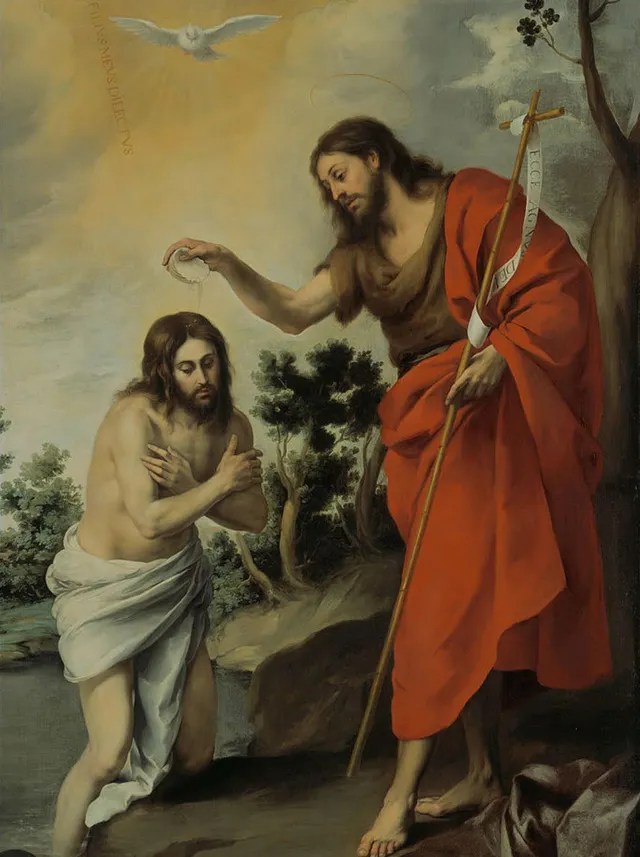
Today’s feast, as has often been remarked, is a feast that presents a bit of a puzzle. Even John seems confused, at least in St. Matthew’s account, as he asks Jesus, I need to be baptized by you, and yet you are coming to me? To which our Lord replies, with a reply that perhaps does not make everything clear, Allow it for now, for thus it is fitting for us to fulfill all righteousness.
(more…) -
La fiesta de hoy es una fiesta que plantea un pequeño enigma. Incluso Juan parece confundido, al menos en el relato de San Mateo, cuando le pregunta a Jesús: Yo soy quien debe ser bautizado por ti, ¿y tú vienes a que yo te bautice? A lo que nuestro Señor responde, con una respuesta que tal vez no aclara todo: Haz ahora lo que te digo, porque es necesario que así cumplamos todo lo que Dios quiere.
(more…) -
In the Book of Genesis, after God had stayed the hand of Abraham as he prepared to sacrifice his son, the Lord spoke to Abraham and said:
Because you have done this, and have not withheld your son, your only son, I will indeed bless you, and I will make your offspring as numerous as the stars of heaven and as the sand that is on the seashore. And your offspring shall possess the gate of their enemies, and by your offspring shall all the nations of the earth gain blessing for themselves, because you have obeyed my voice.
(more…) -
En el Libro del Génesis, después de que Dios detuviera la mano de Abraham cuando estaba a punto de sacrificar a su hijo, el Señor le dijo:
Porque has hecho esto, y no me has negado a tu hijo, tu único hijo, te bendeciré y haré que tu descendencia sea tan numerosa como las estrellas del cielo y como la arena que hay en la orilla del mar. Tu descendencia poseerá las puertas de sus enemigos, y por tu descendencia todas las naciones de la tierra obtendrán bendición, porque has obedecido mi voz.
(more…) -
A little over 2000 years ago, the near east, and Judaea in particular, was in a state of nervous agitation. For some thirty years by this point, Herod the Great, an Edomite who had been appointed as King of the Jews by the Roman Senate, had ruled with great brutality, his reign bringing to an end a hundred years of Hasmonean, i.e. Maccabean rule, which had, for a brief time at least, achieved Jewish independence for the first time since the destruction of Jerusalem by Babylon over 500 years earlier. It was in the wake of this renewed subjugation to foreign power in the form of this puppet king, a subjugation the crowning indignity of which even saw the Roman general Pompey the Great enter into the Holy of Holies, and in the aftermath of a series of civil wars, that Herod had, with Roman backing, achieved in his little client kingdom a sort of murderous peace.
(more…) -
Hace poco más de 2000 años, la tierra de Judea se encontraba en un estado de agitación nerviosa. Durante unos treinta años, Herodes el Grande, un edomita que había sido nombrado rey de los judíos por el Senado romano, había gobernado con gran brutalidad, poniendo fin a cien años de dominio macabeo, una familia que, al menos durante un breve periodo de tiempo, había logrado la independencia judía por primera vez desde la destrucción de Jerusalén por Babilonia más de 500 años antes. Fue en medio de esta renovada subyugación al poder extranjero en forma de este rey, una subyugación cuya indignidad culminó con la entrada del general romano Pompeyo el Grande en el Santo de los Santos, y tras una serie de guerras civiles, que Herodes, con el respaldo romano, logró en su pequeño reino cliente una especie de paz asesina.
(more…)
 PaddlingPadre