
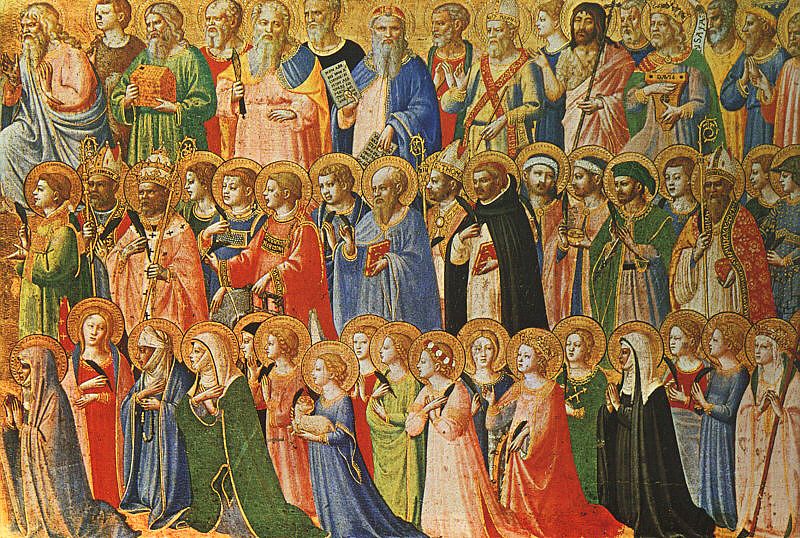
The fate of the saints, who now enjoy the blessed vision of God, can only be, from our perspective, something wonderous and mysterious. In our first reading we were greeted with a mystical vision of their state: a great multitude which no one could count, from every nation, race, people and tongue, standing before the ineffable presence of God in praise, worship, and adoration, together with the angels. The saints, from all times and all places, united together before God’s throne.
And then in our second reading, John talks of the same thing: We are God’s children now, he says, what we shall be has not yet been revealed. We do know that when it is revealed we shall be like him, for shall see him as he is. Again here, we come up against the edge of the mystery, knowing where we shall be and why we shall be changed and who will transform us, yet still merely able to wonder at what it shall be like to enjoy that blessed future state.
That it will be blessed though, of this we have no doubt, for we have Christ’s own words from the Gospel, who, upon telling us all the ways in which we shall be blessed by following his teachings, reassures us and spurs us on by saying: Rejoice and be glad, for your reward will be great in Heaven.
The fate of the saints then, is more than we can describe, greater than we can imagine. For those of us who will persevere and come to that state, we can say that we shall want for nothing then, that grander and more marvelous things yet lie before us than any that we have or will have left behind.
But in order to come to that state, in order to enter in upon the vision of God, we must first be changed. If we think that we could, as we are now, gaze upon the divine presence, then we are being presumptuous; do not forget that the ancients thought that to look upon God meant certain death. And indeed it does. It is not for nothing that we celebrate this feast at the beginning of November, a month set aside for the contemplation of death and for praying for the dead, because the victory of the saints is intimately connected with death.
As a priest, a common enough question that I encounter, either in OCIA or from children who have begun to think on their faith more deeply or even from ordinary Catholics is: why did Jesus have to die in order to save us? The short answer, of course, is that he didn’t. God could have saved us in any way he saw fit. But it was fitting that he chose to come among us and to die in his assumed humanity in order to save us, since by his total self-emptying he reveals the infinite depths of his love for us, but also because (and this is but one aspect of the atonement) because Christ demonstrates for us how sanctification and death go together.
To see this, consider how seldom we desire a religion that truly challenges us, that truly makes demands on us. Very often, we want to keep God in a box, to set limits on the influence which we will permit him in our lives, saying “this far and no further.” In other words, we want to hold a part of ourselves back, whether it be our politics or our entertainments or our petty pleasures or our plans for the future. This is the trap of treating God as if he were a “parachute God” or a “Grandfather God”, something we can turn to if we are really in trouble, or who will spoil us in granting us wishes, but who ultimately stays out of our private affairs and so makes little to no demands on us – to think of God in those terms, usually more or less implicitly – it is no wonder that we hold back, for we hardly register that anything is being demanded of us. The most typical sign of this malady is pride, a bowing up in the face of correction or challenge. Of course, the remedy lies in contemplating the crucifix, for when we look at the crucified Christ – naked, beaten, bloodied, parched and suffocating – we are faced with the question as if it were a rebuke: what did he hold back?
Ultimately, the only offering that we can make to God that will not in the end prove completely absurd is to offer our entire selves, every aspect of who we are, every word and action, every decision, every possession, every hour of every day. As we heard last weekend, You shall love the Lord, your God, with all your heart, with all your soul, and with all your mind. And so, while Christ did not have to die to become holy, we surely must; we must die to the flesh and the world, and to everything that we hold onto as peculiarly our own, emptying ourselves in offering everything that we are to the Father, just as Christ did before us, and as Christ enables us to do in imitation of him by the help of divine grace.
And so: do not put the hard work of dying off until your deathbed. Do not be deceived by this world and the glory of it, by the lying voice of the Devil in the desert. It is in dying to such things now wherein lies the secret of a good and holy death. Indeed, it may even be that you begin to experience something of the resurrection even in this life, which is why some who die seem as though they were not dying, the martyrs especially, and the Blessed Virgin Mary above all.
Now if that sounds daunting, if that task of transformation, of dying to the world, of giving oneself over with total completeness seems intimidating, then take heart in the fact that even now saints beyond number have already gone before us and even now enjoy the Beatific Vision. For us, beatitude is, at least in part, an unknown wonder lying on the other end of a labor that is, for us, still in progress. But for many men and women, for an unnumbered many, this is no longer so, for they have already passed over from wonder and expectation to vision and experience. And while we may not be able to name these saints, for surely only a relative few are named, they are not unknown to us, and this for two reasons:
First, they are, please God, our ancestors, family, friends, and acquaintances. The call to holiness is not something that only goes out to extraordinary individuals, the saints are not far off heroes from a distant age, but are rather men and women who are like us in all things, except only in that they have already gone ahead of us, and, while we yet journey on the way to blessedness, they have already entered the promised land. What hope does this give us for our own salvation, for our own transformation! For truly, if the saints are our fellows, then we too, if we but cooperate with God’s grace, must be the stuff of saints!
And, second and more profound, the saints are not unknown to us because they are with us even now, in this very liturgy even. They are our fellows not only in the sense that they were like us during life, and perhaps knew us during life, but more so because they are in this very moment united with us, above all in this celebration, and when we in our turn pass over into glory we will see how this has always been so, how we have always been members of the one body of Christ, the one indivisible and catholic church which extends beyond the reach of death.
And so on this feast, we honor these numberless unnamed saints, and we celebrate their victory, even as we simultaneously gird ourselves so as to make their victory our own, so that this their feast shall one day be ours as well. And in this, we implore their intercession, so that by their help we might come to join them in paradise.


Leave a Reply