
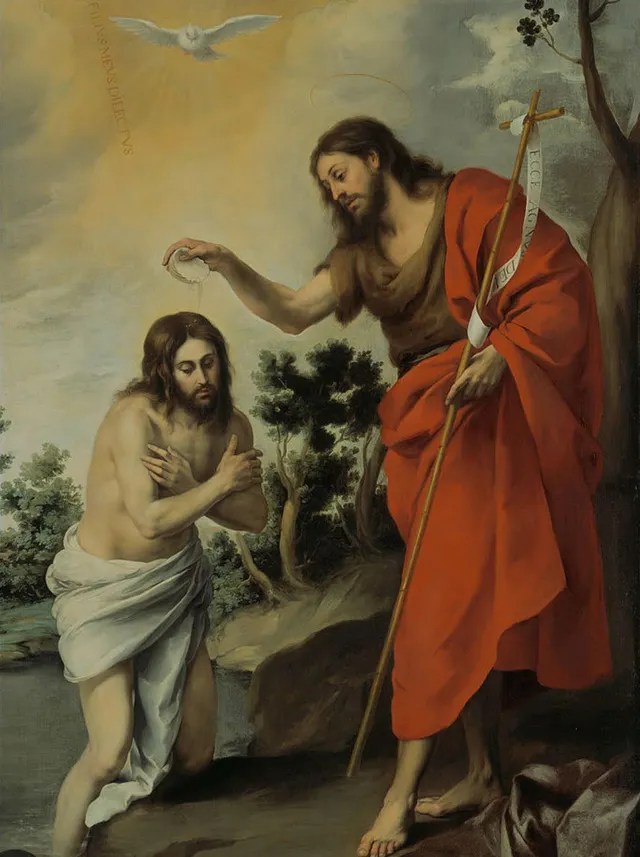
Today’s feast, as has often been remarked, is a feast that presents a bit of a puzzle. Even John seems confused, at least in St. Matthew’s account, as he asks Jesus, I need to be baptized by you, and yet you are coming to me? To which our Lord replies, with a reply that perhaps does not make everything clear, Allow it for now, for thus it is fitting for us to fulfill all righteousness.
So why then was our Lord baptized by John, who we know was administering a baptism of repentance? What does our Lord mean when he speaks of fulfilling all righteousness? Well, we can say in the first place that this does not mean that Jesus himself needed to repent, as John himself recognizes in the gospel. Jesus, after all, is the incarnate Second Person of the Blessed Trinity, and so is sinless. And so, not needing repentance, we are not dealing here with a matter of necessity. In other words, if the question was: “Why did Jesus need to be baptized by John?” then the answer would be: “He did not need to be baptized.” The proper question then, as Jesus indicates in his reply, is not one of necessity but rather of fittingness: “Why was it fitting that Jesus was baptized?”
To fulfill all righteousness is, of course, the answer that springs to mind, but it is an answer that, for us at least, requires some fleshing out, and there are a few things, I think, that could be said to that end.
First, there is the aspect of our Lord’s baptism that is most obvious in this gospel. For after he was baptized, behold, the heavens were opened for him, and he saw the Spirit of God descending like a dove and coming upon him. And a voice came from the heavens, saying, “This is my beloved Son, with whom I am well pleased. This episode of our Lord’s baptism, then, has this revelatory character about it, as not only John, but the Father and the Spirit as well, give testimony to Jesus’ identity as well as to his mission, and from this moment his work begins in earnest. The silent years of Nazareth are ended – Matthew, Mark, and Luke all tell of how Jesus immediately after this episode is driven into the desert by the Spirit in order to fast and be tempted, and John the Evangelist tells us that he at once begins to gather to himself the first of his disciples. From this moment, in other words, the public ministry of Jesus is begun, and this public manifestation of Jesus’ divine Sonship serves to declare this fact.
A second reason for the fittingness of our Lord’s baptism concerns that objection of John with which we started: I need to be baptized by you, and yet you are coming to me? For truly Jesus had come in order to baptize, as he would command his disciples following his resurrection: Go and make disciples of all nations, baptizing them in the name of the Father, and of the Son, and of the Holy Spirit. This, of course, is the very baptism that we have all received and by virtue of which we are made worthy to celebrate these sacred mysteries, and Jesus prepares this reality for us by sanctifying the matter of the sacrament, namely the flowing waters, by his own submersion in the Jordan. It is not, then, that he is washed clean by the waters, but rather, by his own baptism, he makes the waters clean.
And this brings us to a third reason for the fittingness of our Lord’s baptism: it is an act of divine condescension, a continuation, you could say, of the logic of the Incarnation. For what is the Incarnation? It is, among other things, God’s free decision to come and dwell among us, for Him who is infinite and all-powerful to take on the weakness and limitation of human flesh. There is a sense, clearly, in which doing this is beneath God’s dignity as the Most High, and it is certainly not anything that he needs to do or anything that he owes us. And yet, the love of God is so marvelous and so infinite that out of love he deigns to traverse that infinite distance between the heights of heaven and a cave in Bethlehem to be born a human child. And that same divine condescension, by which, out of love, he took to himself our weakness, moves him also to undergo this baptism which he needs as little as he needs a human body – He is baptized, that is to say, out of love for us and in order to reveal his love and to invite us into his love.
Because the Incarnation, as rightly as we focus on its metaphysical reality of God taking to himself a human nature (given that our salvation depends on this fact, as Nazianzus says, “For that which he has not assumed he has not redeemed,”) was not a taking on of human flesh only, but also the entering in to a particular society and a particular people. This is why, for instance, Jesus does all kinds of things that might easily confuse us, of which his baptism is but one example, such as his following the Jewish law, being circumcised, and even praying at particular times and in particular ways, all of which could strike us as superfluous, since why should God himself pray to God?
And of course, there is a sense in which it is superfluous – it is as superfluous as the Incarnation itself. For God did not need to become Incarnate, and he did not need to be baptized, and he does not need our prayers. But if we are to come to share in the divine life, as God in his love for us desires, then we need the Incarnation, we need to be baptized, and we need to pray, for such is our nature that without such practices our religious sense withers and warps until we ourselves become twisted, isolated, and lost.
And so yes, Christ does things that he does not need to do, and he does them for our sakes. He is baptized, though he needs no baptism, in order that we might be purified. He submits to all manner of Jewish ritual, in fact, in order to teach us the type of devotion and piety by which one of mortal flesh draws close to God, even as he institutes a new law and new rites by which that ancient piety is deepened and purified. And he prays in order to teach us how to pray.
And so if this is how God himself behaved when in the flesh, then how greatly should we strive to imitate him! For if he behaved thusly towards religious rites and practices when he did not himself stand in need of salvation, how seriously should we take these same things upon which our very salvation depends! For in our zeal for spiritual things, which is of course good, we must never forget that we are human beings, and that we come to such things, not as angels or pure spirits, but precisely as human beings, as flesh and blood, as God communicates his life to us through things that we can see and touch, hence the tangibility of the sacraments and the visibility of the Church. And so how blessed are we to have a Savior who not only has opened a way for us to reach God, but has himself walked it, even when he had no need to, teaching us by his own example, beginning with his baptism in the waters of the Jordan.
 PaddlingPadre
Leave a comment