
In the Book of Genesis, after God had stayed the hand of Abraham as he prepared to sacrifice his son, the Lord spoke to Abraham and said:
Because you have done this, and have not withheld your son, your only son, I will indeed bless you, and I will make your offspring as numerous as the stars of heaven and as the sand that is on the seashore. And your offspring shall possess the gate of their enemies, and by your offspring shall all the nations of the earth gain blessing for themselves, because you have obeyed my voice.
This promise, made at the very beginning of God’s relationship with his chosen people, is one of the truly foundational promises of the covenant. Not only would Abraham’s descendants be numerous, not only would they prosper themselves, but, through them, all the nations of the earth would be blessed. And so we see, even as God reaches out in a very particular way to a very particular family, that he does so with the intention, from the very beginning, of achieving something universal, namely the blessing of the entire world.
Now, there is much in this promise that is left, at the time at least, unexplained. Why, for instance, does God insist on blessing the nations of the earth through Israel, rather than blessing them directly? One can imagine how such a promise must have sounded to gentile ears. The answer, of course, is that in preparing a people peculiarly his own, God is leading that people into a deeper relationship with himself, so that they in, coming to know him and his wisdom, can reflect that reality to the world, radiating for all peoples the wisdom and the knowledge of God. (Naturally one sees a prefigurement here of the evangelizing mission of the Church).
But if such was the intention, what was the result? Well, God continued to deepen his relationship with Abraham, and then with Isaac and Jacob. And then eventually, when Jacob and his sons had traveled to Egypt and their descendants had been enslaved by Pharaoh, God freed them from their captivity and, through the ministry of Moses and Aaron, he made a covenant with them and gave them a law, and by the hand of Joshua delivered them to the Promised Land. And when yet more time had passed, he chose a man after his own heart, David from the tribe of Judah, to shepherd his people, and established David’s kingdom over all Israel, pouring out wisdom and prudence to Solomon, David’s son, who finished the construction of the Temple in Jerusalem and brought the splendor of Israel to its zenith.
And so surely, if ever there was to be a time in this long story when Israel would be a light to the nations, a blessing for all peoples, it would be here, when his splendor was brightest. And indeed, one sees this promise of blessing beginning to be fulfilled – the queen of Sheba hears of the fame of Solomon and comes from afar, bearing gifts and glorifying God, as the Book of Kings tells us: the whole earth sought the presence of Solomon to hear his wisdom.
But then, things go horribly wrong. Solomon becomes corrupted by idolatry, trading the wisdom God had gifted him for foolishness. Because of his sin, the kingdom is divided, and, far from being a light and a blessing to the nations, Israel and Judah become, to a great extent, just two more dark and superstitious little kingdoms, consumed nearly as much with paganism and idol worship as their neighbors, but made worse by their faithlessness to the covenant, until in time both kingdoms, first Israel and then Judah, are destroyed and their people led away into exile.
And yet, this failure does not negate the Lord’s promise to Abraham, for human faithlessness has no power against his providence. And so, even in the midst of the darkness one hears the prophets proclaiming to Jerusalem, as we read from Isaiah: Darkness covers the earth, but upon you the Lord shines. Nations shall walk by your light, and kings by your shining radiance. Raise your eyes and look about; you shall be radiant at what you see.
Clearly, then, even in the disaster of the exile, God had a plan for realizing the blessing of the nations which he had long ago promised would take place through Israel, and during this Christmas season we celebrate its realization. For in Christ, born a son of David, all the nations of the world truly have been blessed – in him the destiny of Israel has been fulfilled. For now God has been revealed to us, he has come dwell among us, he has taken our very nature into his own person. This radical self-revelation of God is something utterly new. As St. Paul tells us in our second reading, It was not made known to people in other generations as it has now been revealed to his holy apostle and prophets by the Spirit: that the Gentiles are coheirs, members of the same body, and copartners in the promise in Christ Jesus through the gospel.
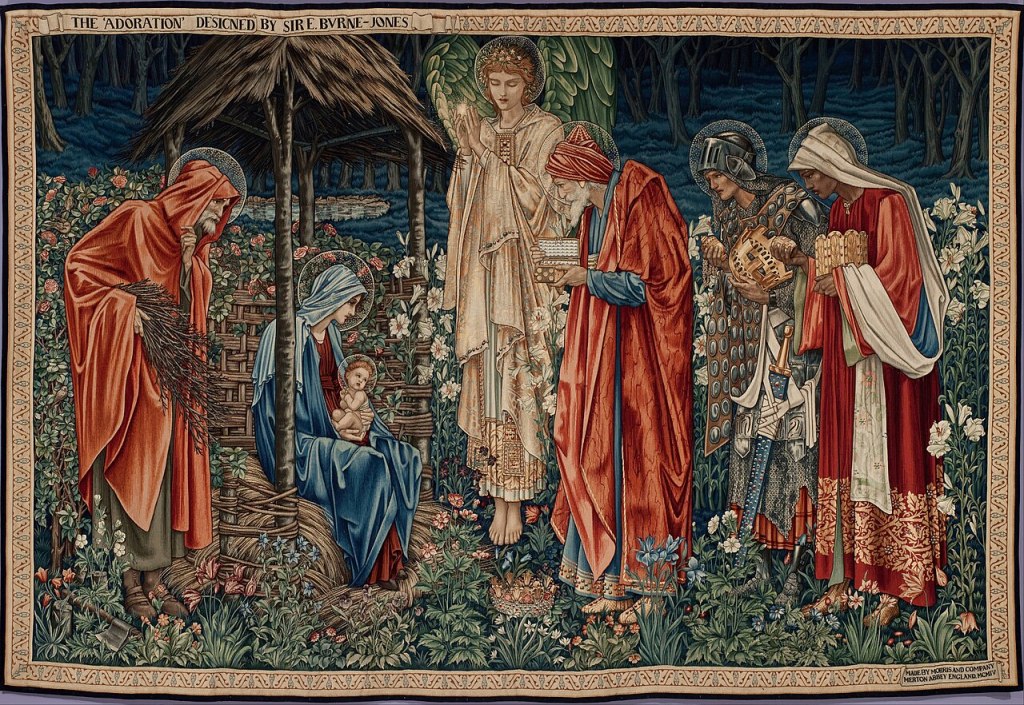
And how fitting is it, then, that even in his infancy we see this good news prophetically prefigured, as the magi, representing in their persons all the gentile nations, come to see this newborn king bearing gifts, even as the queen of Sheba had once done for Solomon his ancestor? But whereas the wisdom of Solomon had failed, the wisdom of Christ, the Wisdom of God, would never fail – the light that had begun to shine in the world that Christmas night would never cease, and it has never ceased and will never cease.
Indeed, it was then only beginning to wax in splendor. For our Lord had still to grow in wisdom and stature, and in favor with God and man, through the hidden years of his life in Nazareth. He had still to call his disciples, still to preach the kingdom, still to suffer and to die and to rise. And it is in that specifically, in his crucified and risen body, revealing at once both the infinite love of God that condescended to death on a cross as well as the infinite power of God that overcame that death, in that same body made present to us in this sacrament, wherein that light shines most brilliantly, wherein the great blessing to the nations foretold to Abraham, revealed now by the Spirit as the salvation of the world, the salvation of you and me and everyone who will accept it, is at last realized and consummated. For in him was life, and the life was the light of all people. The light shines in the darkness, and the darkness has not overcome it.
 PaddlingPadre
Leave a comment