
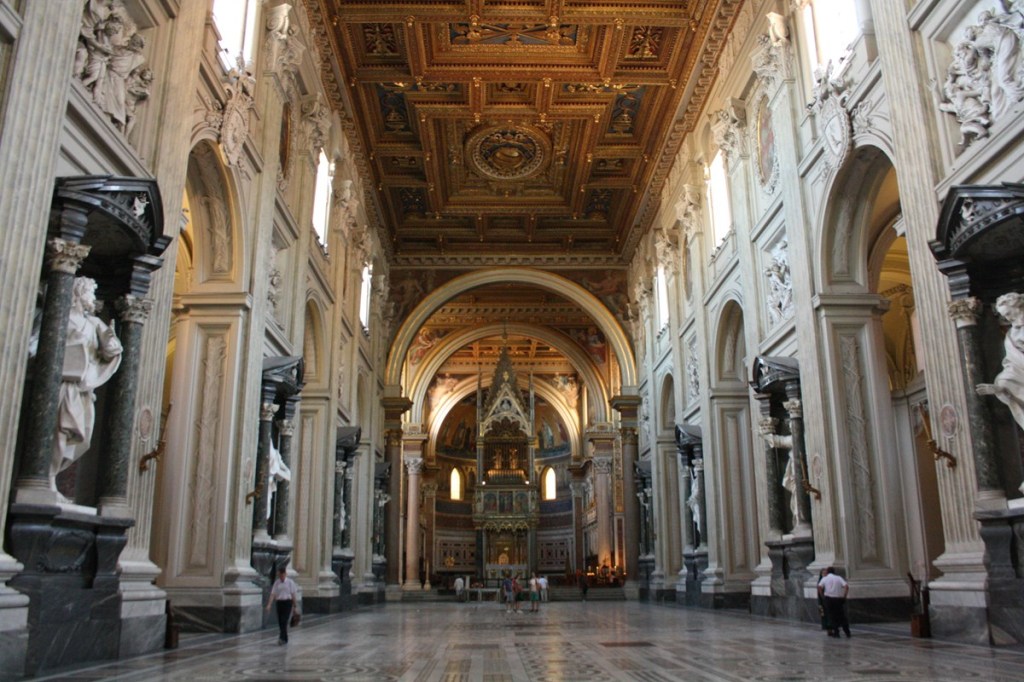
As you can tell from our white vestments, we are not today marking the 32nd Sunday in Ordinary Time, as you might have expected, but instead we have the privilege this morning of celebrating the feast of the Dedication of the Lateran Basilica in Rome.
Now this is, admittedly, a unique sort of feast. There, is, of course, no saint by the name of John Lateran, and it may perhaps strike you as odd that the commemoration of the dedication of a basilica in Rome should be treated as being of so great importance that it takes precedence over a Sunday not only in Rome, but across the entire world. The answer to this riddle, of course, is that St. John Lateran is not just any basilica. Its full name perhaps gives a better indication of its greatness. In the year three-hundred-and-twenty-four, during the reign of the Emperor Constantine the Great, this first of the Christian emperors gave the bishop of Rome what had until that time been the palace of Laterani family, which was thereafter reconstituted as the mother church of the city of Rome, coming to bear the name of Major Papal, Patriarchal and Roman Archbasilica, Cathedral of the Most Holy Savior and Saints John the Baptist and the Evangelist in Lateran, Mother and Head of All Churches in Rome and in the World.
Mother and Head of All Churches in Rome and in the World – this is the Pope’s own Church, the Pope’s own Cathedral, and as such, we as Catholics, who at all times must be marked by our filial love and affection for the Holy Father, united as we are under Peter and his successors as Christ’s vicars on earth, approach this celebration as being not just the commemoration of a building, not just an anniversary of a dedication, but rather as being a celebration and an affirmation of our Catholic identity.
And so what is this Catholic identity which we affirm and celebrate? Above all it is, of course, our belonging to Christ through baptism and the other sacraments. But in addition, and more distinctive (though certainly less fundamental than the sacraments), is the proper recognition that we have as Catholics, in contrast perhaps with certain Protestant groups, that none of us are in this alone, that none of us are isolated, do-it-yourself Christians. None of us belong to a church of our own making or follow a gospel of our own conceiving, but rather all of us are members of something that is bigger than we are, something that has a history behind it, a sacredness to it. In other words, as Catholics, we are part of a community, part of a visible society that has been willed by Christ and which is, as the word Catholic itself indicates, universal in scope.
This is something that you see quite beautifully, I think, in the baptism of infants. For a child, when they are baptized, is not yet able to profess the faith, not yet able to actively and consciously choose Christ, and yet they are, by that baptism, truly made members of Christ and his Church in a way that is totally gratuitous. A baptized child is baptized into the faith, the faith that is the faith of the child’s parents, godparents, and wider parish, such that the faith for that child, as the child grows, is something that is, at each moment of that child’s development, received as a gift within the bounds of this community which is the domestic and local church.
And this is true for all of us, whether we were baptized as infants or later in life: the faith into we have been reborn, the faith which we profess, is something that we have received in and through the community that is the Catholic Church. For this is how God has willed it. Before he ascended, Christ chose the Twelve and commissioned them to go throughout the world, baptizing all nations in the name of the Most Holy Trinity, and they in turn appointed bishops and successors in the towns and cities in which they preached, all of whom handed on the what they had received (as did their successors in turn), ever guarding that apostolic tradition of the Church, a tradition which was strengthened and guarded above all by Peter’s successors in Rome, in fulfillment of Christ’s words that his Church would be built upon Peter, who was especially charged by Christ with the task of strengthening his brethren.
It is, then, within this hierarchical communion, the foundations of which are the apostles and the earthly head of which is the successor of Peter, that Christ has willed to continue his salvific work on earth and in which we have received the faith which possess. It is because of this that the Pope’s own cathedral, dedicated one-thousand-seven-hundred-and-one years ago today, can be called the mother of all the churches in the world, for truly the Church is our mother, not only in a mystical sense, but even as we see her with her hierarchies and cathedrals and dogmas and teachings – it is in these and through these that we have received the faith which we profess.
And even as a child is called to demonstrate a filial piety towards his or her parents from whom the child receives all that he or she has, so too are we called to exercise a filial piety towards the Church and her hierarchy, particularly the Holy Father, to whom is entrusted the governance and safe keeping of the Church which Christ established. We can forget this sometimes, especially living in America, where we can easily make the mistake of thinking of the Church as if it were a democracy (which it is not) or we can, perhaps without realizing it, slip into a consumerist mentality where we demand that the Church adapt itself to our tastes and preferences, whether that be politically, liturgically, or theologically. The antidote to such impious tendencies is obedience – obedience to our pastors, to our bishops, and to the Pope, for it is in obedience, rather than in protestations or self-will, that the communion which Christ desires for his Church is protected.
And so, it is with joy that we celebrate this feast of the Church’s Catholicity in the dedication of St. John Lateran, for that Catholicity truly is a joy. It because the Church is Catholic that it has reached out even to us in these latter days and on this distant continent in order to bring us to faith, and it is, for our part, a great blessing and joy and privilege for us to be members of this One Holy and Catholic Church, and to be subjects of the ancient and Apostolic See of Rome, guided by the successors of Peter, the chief of the apostles of our Lord and Savior Jesus Christ.
 PaddlingPadre
Leave a comment